
Federal BOP Release Records
The Federal Bureau of Prisons manages people serving federal prison sentences. It is not the Gasconade County Sheriff, a housing jail, or the Missouri Department of Corrections. A county arrest can move into a federal path when a federal warrant, federal charge, or federal court order controls custody. The county movement record should identify the receiving authority when that information is public, but the later federal release record belongs to the federal system.
A BOP record may show a historical release date and wording such as released or not in BOP custody. That statement concerns BOP custody. It does not by itself rule out a later transfer, another warrant, immigration detention, or state custody. The physical movement and the legal order must be matched when the destination matters.
| System | Best public route | What it can establish |
|---|---|---|
| BOP | Inmate Locator | Federal sentence custody and a historical release date |
| USMS | Federal docket and records request | Federal pretrial custody and transport |
| ICE | Online Detainee Locator | Present detention and some recent release coverage |
| MODOC | Offender Search and records | Missouri prison custody or active supervision |
| County housing jail | Custodian inquiry and movement record | Local door time, transfer, authority, and destination |
Search Federal BOP Releases
Use the official BOP Inmate Locator for a person who served a federal prison sentence. Search by the federal register number when known. The locator also permits a name search with available biographical fields. A common name can return several people, so compare the middle name, age, race, sex, and register number displayed before accepting a match.
- Choose the register-number search when a BOP, FBI, DCDC, or INS number is known.
- Otherwise search the full name and use the available identity fields to narrow the result.
- Open the correct record and copy the status wording and release date exactly.
- Check the federal court docket if the order or later case action must be confirmed.
- Follow any transfer shown by the last county, USMS, BOP, or immigration record.
BOP cautions that historical information can be incomplete or inaccurate, especially in older records. A locator result is a strong lead, but it is not a complete federal case file. If the date or destination needs formal proof, request the relevant BOP record and compare it with the federal docket and the last custodian's movement entry.
“Not in BOP custody” does not always mean free in the community. Another federal, state, local, or immigration authority may hold the person.
BOP Released Record Wording
The BOP explains its public record coverage and the limits of historical entries on the locator's official records page. The screenshot below is tied to that federal source, not to a commercial name database.
Open the official BOP release locator.
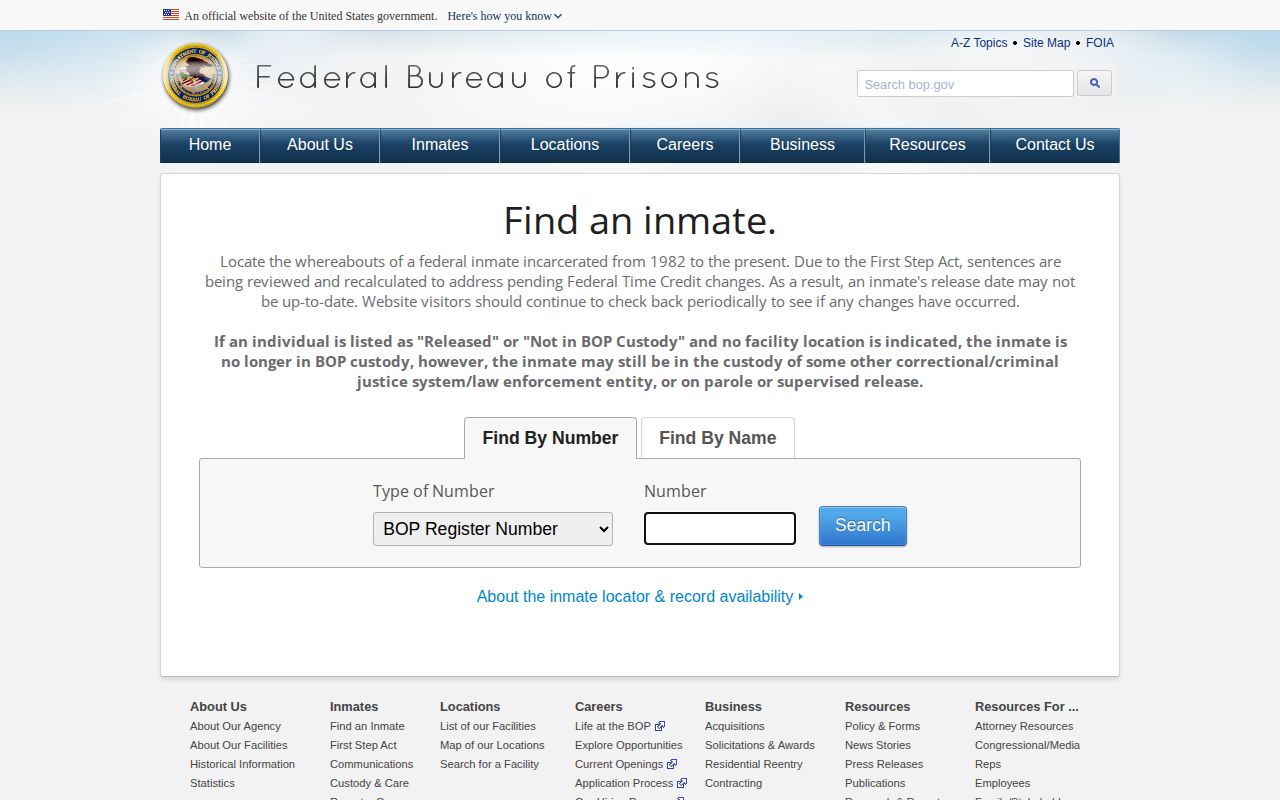
Read the locator's date and status as BOP information only. Then check another custody system if the local or federal record points to a transfer.
- Register number
- The federal identifier used to distinguish people in BOP records.
- Released
- A BOP status paired with a federal release date, subject to the locator's data limits.
- Not in BOP custody
- A statement that BOP does not currently hold the person, not proof of community release.
- Detainer
- A request or notice that another authority may take custody when the present custodian releases the person.
USMS Federal Release Records
The U.S. Marshals Service often handles federal pretrial prisoners and transportation. It can use contract facilities, including local jails, without turning that person into a county prisoner for record-search purposes. A person can disappear from a local roster because USMS moved them, not because they entered the community. Likewise, a federal court may order release from USMS custody before an ordinary BOP sentence record exists.
No public USMS historical name locator comparable to BOP was found. The USMS prisoner information explains the agency's custody role. The federal court docket supplies the legal side of the event, while a USMS Freedom of Information Act request can seek custody records. Use the name, federal case number, district, approximate dates, and the specific movement or release information sought.
Do not substitute BOP for USMS. BOP is most useful after commitment to a federal prison sentence. USMS records are more likely to control the pretrial and transport stage. The county or housing-jail movement log can bridge the two by naming the authority that accepted the person.
ICE Release and Detention Checks
Immigration custody uses the ICE Online Detainee Locator System, not the BOP locator. Search by the nine-digit A-number and country of birth, adding leading zeroes where the official instructions require them. The alternate route uses exact first and last name, country of birth, and an optional birth date. The ICE resource covers people currently detained and certain people released in the prior 60 days.
A not-found result is not a release certificate. It can reflect a release outside that recent period, removal, transfer, spelling differences, processing delay, an age-based exclusion, or a record withheld from display. If a Gasconade County sheriff or housing-jail record states an ICE hold or transfer, combine that movement entry with ICE confirmation. The federal locator should not erase what the sending jail documented.
ICE's Detention Reporting and Information Line is 1-888-351-4024, Monday through Friday from 8 a.m. to 8 p.m. Eastern, for basic case inquiries. This is a federal information route. It is not a Gasconade County recent-release list and it cannot supply the local court disposition.
Gasconade Federal Release Chain
Gasconade County is a fragmented-custody county even before a federal agency enters the case. Approved County Commission minutes document boarding local prisoners in Franklin and Osage counties. Osage temporarily closed its jail for staffing in July 2025 and sent prisoners to other counties. That history means the last visible facility can change, and a dated custody map matters more than a static page that labels one building as “the jail.”
Start with the Gasconade County Sheriff's Office when the arrest or transfer began locally. Ask which jail physically held the person on the relevant date and whether departure meant community release or delivery to another authority. Request the transfer destination and effective time. If the record names USMS, BOP, or ICE, move to that federal path. If it names MODOC, use the state offender and discharge route instead.
The legal and physical records answer different questions. A federal docket can show an order, bond term, sentence, or dismissal. The jail or USMS movement record shows when custody changed hands. BOP shows federal prison status and may preserve a historical release date. ICE supplies a limited current or recent detention check. Joining those records avoids calling a transfer a release.
Request Federal Release Records
A focused federal request should identify the person, register number when known, federal case number, facility or district, and a narrow date range. Ask for the specific release, transfer, or custody-movement record needed. Broad requests can be harder to process and may collect protected material that is not relevant to the release question.
Older BOP data may require further archival research. A federal record may also omit state or county events that happened before federal acceptance or after federal release. Keep a short source log with the exact status language, date viewed, date field label, and agency. This is especially useful when a locator changes after a later transfer or correction.
The Gasconade County release records search covers the local starting point and the court, MOVANS, MODOC, and records-request fallbacks. Use it to identify whether the case actually entered the federal system before relying on BOP. When the federal link is confirmed, the BOP locator and the responsible federal records office are the authoritative next steps.
Identity matching deserves the same care as custody matching. A BOP register number is more reliable than a name alone. When only a name is available, compare every public biographical field and the federal case before joining records. Do not assume that a similarly named person in the national locator is the person from the Gasconade event.
Finally, ask whether the listed date is a sentence release date, a transfer date, or merely the last date in the public locator. A federal court order can explain the authority but may not show the moment the person left a building. The custodian's movement record supplies that physical detail. If another agency took custody, continue with that agency rather than describing the BOP departure as an unrestricted community release.
Precise labels prevent false release conclusions.